Making 3D printing feel like buying something, not manufacturing it.
Womp makes 3D sculpting accessible to anyone. We designed an end-to-end printing pipeline that translates manufacturing constraints into an intuitive checkout flow.
Lead Product Designer
Sole design owner
3 Months
End-to-end to production
Womp Core Team
Critique w/ 2 designers & eng
Canvas to Doorstep
Funnel, cart & checkout
Project Context
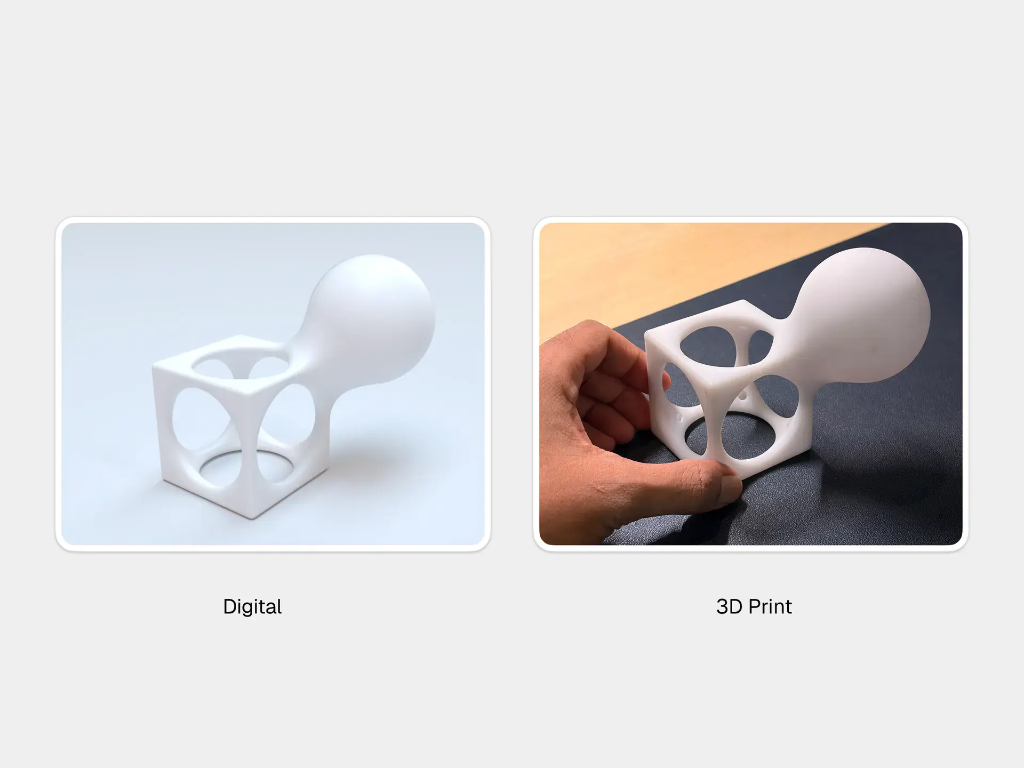
Democratizing physical output
Womp removed the CAD barrier for 3D art, but fabricating physical objects remained an intimidating technical obstacle for non-engineers.
Confidence without manufacturing jargon
Creators wanted to order their sculpts without calculating wall thicknesses, resin drainage, or build plate orientations.
A sustainable second revenue pillar
Fabrication introduced a physical monetization stream alongside software subscriptions, expanding creator lifetime value.
Physical laws cannot be negotiated
Digital sculpts can float or have paper-thin walls, but physical SLA prints require watertight geometry, supports, and drainage.
Design Process
Separating creation from print prep
Clicking Print locks editing brushes and switches the viewport into an inspection studio, preventing accidental edits during validation.
Print Mode Transition Interface
[UI Placeholder: Sculpting sidebar collapsing into inspection camera view with material options]
Figure 1: Switching from creative sculpting mode to dedicated manufacturing preparation.
Material selection with tactile clarity
Replaced chemical specs with tangible materials: Prototyping White for paintable detail and Clear Optical for polished presentation.
White Prototyping Resin
Matte • High detailClear Optical Resin
Translucent • Polished[UI Placeholder: Material picker cards with realtime 3D viewport reflection update]
Figure 2: Material selection cards explaining tactile characteristics and surface finish.
Volumetric sizing within print bed envelopes
Interactive millimeter rulers and visual bounding envelopes highlight print bed limits, with one-click proportional scaling if exceeded.
Interactive Bounding Box Controls
[UI Placeholder: 3D model enclosed in parametric bounding box with millimeter rulers]
Figure 3: Visualizing printer build limits with interactive bounding controls.
Automated hollowing and drain port snapping
Hollowing saves ~40% in material costs. The system computes wall thickness in 3 seconds and highlights intuitive drain placements on an X-ray view.
Translucent Hollow Inspection & Drain Ports
[UI Placeholder: X-ray cutaway showing inner hollow chamber with smart drain port snapping indicators]
Figure 4: Cutaway preview of hollowed interior geometry with drainage placements.
Pre-flight validation and fragile heatmaps
Instead of arbitrary errors, fragile zones under 1mm are shown on a color heatmap, allowing creators to accept informed risks for fine details.
Pre-Flight Verification Checklist
[UI Placeholder: Thickness heatmap on model with an informed creator override toggle]
Figure 5: Pre-flight checklist distinguishing between fatal errors and creator overrides.
Volumetric pricing with zero surprise costs
Hollow pricing is anchored early to avoid sticker shock, with real-time tax and courier delivery calculated upfront.
Transparent Checkout Experience
[UI Placeholder: Checkout drawer showing volumetric resin breakdown and doorstep shipping]
Figure 6: Final checkout flow anchoring realistic costs and delivery expectations.
Key Trade-offs
Sequential Flow over Freeform Sidebar
Because material choices change hollowing and drain needs, a step-by-step pipeline eliminated invalid configurations.
Visible Progress over Silent Loading
Hollowing requires heavy 3D geometry computation. An X-ray progress preview made the 3-second wait informative.
Early Hollow Pricing over Hidden Add-ons
Displaying hollow pricing early set attainable cost expectations and motivated creators through checkout.
Informed Overrides over Hard Blocking
Explaining specific fragile risks and letting artists accept them preserved creative intent on delicate sculpts.
Outcomes & Impact
A Core Second Revenue Pillar
Physical printing opened a brand new revenue stream that scaled alongside Womp's software subscriptions.
Fewer Manufacturing Failures
Pre-flight boundary and wall checks caught errors before jobs reached manufacturing, keeping scrap rates low.
Consumer-Grade Checkout Funnel
Turned complex custom manufacturing into a seamless ordering experience comparable to modern consumer commerce.
Current Status
Shipped to production worldwide. The 3D printing workflow remains an active revenue driver for Womp, bridging digital modeling and physical keepsakes every day.
What I Learned
When software connects to physical manufacturing, you cannot simply simplify the underlying physics away.
The design challenge is deciding what the software manages silently, and where the human creator must remain in full control.
"Make the process simple without pretending the underlying problem is simple."